12V Power Systems for Ute Canopies and Trays: Sizing, Wiring and Buying in 2026
Author: EZ Toolbox Date Posted:16 September 2026

Work out your daily amp-hours first, then buy. A 12V fridge is 30–60 Ah/day, power tool charging 10–20 Ah/day, lights and phones 5–10 Ah/day. A tradie who charges tools and runs a work light needs roughly 100 Ah of usable capacity; a touring family running a fridge, lights and devices needs 200–300 Ah. Then add a DC-DC charger so the alternator actually charges the battery, and solar if the vehicle sits still during the day. We package this as complete systems from $799 for a Power Hub with 40 A DC-DC and MPPT up to $5,499 for a full 12V Smart Touring Hub. Browse: ETB 12V Systems.

What this guide covers
- The amp-hour maths, in plain language, with real Australian load figures
- Lithium (LiFePO4) vs AGM — including the payload and cold-morning arguments
- Why a DC-DC charger is not optional on a modern ute
- Solar: how much you need, and when it is a waste of money
- Inverters, and the honest answer about running power tools from one
- Where the battery physically goes in a canopy, and the safety rules that apply
- Complete system packages and 2026 Australian prices
Step 1: Work out your daily amp-hours
Every good 12V system starts with one number — how many amp-hours (Ah) you consume in 24 hours. Everything else follows from it. Here are realistic Australian figures.
| Load | Typical draw | Daily consumption | Notes |
|---|---|---|---|
| 40–60 L 12V fridge | 3 – 5 A when running | 30 – 60 Ah/day | Doubles in a Queensland summer or if the canopy sits in the sun |
| LED strip lighting | 0.5 – 2 A | 2 – 6 Ah/day | See 12V LED strip lights |
| Power tool battery charging | 5 – 10 A while charging | 10 – 20 Ah/day | Usually via an inverter — add 10–15% conversion loss |
| Phone, tablet, radio, UHF | 1 – 2 A | 5 – 10 Ah/day | Small but constant |
| Laptop (site supervisor) | 3 – 5 A via inverter | 10 – 20 Ah/day | Inverter losses matter here |
| Diesel heater | 8 – 10 A start, 1 A run | 10 – 25 Ah/night | Alpine and winter touring |
| Water pump | 4 – 6 A intermittent | 2 – 5 Ah/day | Negligible unless you shower off the ute |
| Air compressor | 20 – 40 A intermittent | 5 – 10 Ah/use | Short, high draw — size the cable, not the battery |
The usable-capacity trap. A 100 Ah AGM battery gives you about 50 Ah of usable capacity, because discharging AGM below roughly 50% destroys it quickly. A 100 Ah lithium (LiFePO4) battery gives you 80–95 Ah usable. So a “100 Ah” lithium is closer to two AGM batteries in real terms — and weighs about a third as much. When you compare prices, compare usable amp-hours, not nameplate amp-hours.
Two worked examples
Tradie, metro, home every night. Fridge in summer only (40 Ah), tool charging (15 Ah), lights and phone (8 Ah) = roughly 63 Ah/day, but the vehicle drives daily so the alternator does the work. A 100 Ah lithium with a 40 A DC-DC charger is ample, and solar is optional.
Touring family, four days off-grid. Fridge (50 Ah), lights (5 Ah), devices (10 Ah), water pump (3 Ah), occasional inverter use (15 Ah) = roughly 83 Ah/day. Over four days that is 332 Ah. You need 200–300 Ah of lithium plus meaningful solar, or you need to drive every second day.
Step 2: Choose the battery chemistry
| Factor | Lithium (LiFePO4) | AGM / lead-acid |
|---|---|---|
| Usable capacity | 80 – 95% of nameplate | ~50% of nameplate |
| Weight per usable Ah | Roughly one third of AGM | Heavy — a 100 Ah AGM is around 30 kg |
| Cycle life | 2,000 – 5,000+ cycles | 300 – 700 cycles |
| Charge speed | Accepts high current — recharges fast | Slow absorption phase; long tail |
| Voltage under load | Stays near 13 V until nearly empty | Sags steadily — fridge cuts out early |
| Cold weather | Should not be charged below 0 °C without BMS protection | Tolerates cold charging |
| Purchase price | Higher up front | Lower up front |
| Cost per usable Ah over life | Substantially lower | Higher — you replace them more often |
| Payload impact | Minimal — matters on a loaded ute | Significant |
For an Australian ute build the payload argument usually settles it. You have already spent 300–450 kg of legal payload on a tray and canopy (see the tray guide); spending another 60 kg on lead when 20 kg of lithium does the job better is hard to justify. AGM still makes sense on a tight budget, on a vehicle that lives in genuinely sub-zero conditions, or where the system is rarely cycled.
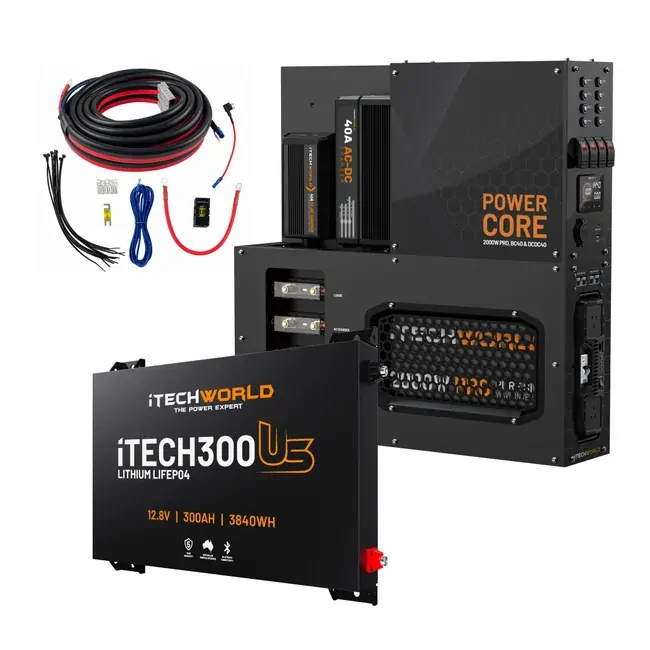
Our battery range and slim-format options like the 300 Ah Ultra Slim Power Core ($4,604) are designed to fit under a canopy shelf rather than eat floor space — which in a canopy is worth as much as the capacity.
Step 3: Charging — why a DC-DC charger is not optional
On an older vehicle you could run a simple isolator and let the alternator top up a second battery. On a modern ute you cannot, for two reasons.
- Smart alternators. Most current utes use a variable-voltage alternator that drops output once the start battery is full — often to around 12.5 V. That is below what an auxiliary battery needs to charge, so a plain isolator leaves your second battery permanently half full.
- Lithium needs a proper profile. LiFePO4 requires a specific charge curve and a BMS-friendly approach. A DC-DC charger delivers that regardless of what the alternator is doing.
A DC-DC charger takes whatever the alternator gives and boosts it to a correct, current-limited charge. Sizing is simple: a 25 A unit suits systems up to about 100 Ah, a 40 A unit suits 100–300 Ah. Our Power Hub — 12 V 40 A DC-DC and MPPT at $799 (RRP $1,150) combines both functions in one unit, which is the tidy way to do it in a canopy where every millimetre of wall space is spoken for.

Solar: how much, and when it is wasted money
Solar earns its keep when the vehicle sits still during daylight — a base camp, a beach, a long weekend. It earns very little when you drive every day, because the alternator through a 40 A DC-DC charger will always out-perform a roof panel.
- Rule of thumb: 1 W of panel returns roughly 0.25–0.35 Ah per day in real Australian conditions, averaged across seasons and allowing for dust, angle and cloud.
- So a 200 W panel returns roughly 50–70 Ah on a good day — enough to run a fridge, not enough to also charge tools.
- An MPPT controller extracts meaningfully more than a PWM controller from the same panel, especially in partial shade and in cooler weather.
- Fixed panels on a canopy roof are convenient but always at the wrong angle; a portable blanket you can aim at the sun will out-produce a bigger fixed panel. Many tourers run both.
Step 4: Inverters and running 240V gear
An inverter converts 12 V DC to 240 V AC so you can run mains equipment. The honest guidance:
- Small loads are fine. Laptop, tool battery chargers, a camera charger, a small fan — a 600–1000 W pure sine inverter handles these comfortably.
- Large loads are expensive. A 2000 W inverter pulling full load draws around 180 A from the battery. That empties a 200 Ah lithium in about an hour and needs very heavy cable. If you need to run a grinder or a demo saw all day, a generator or a mains lead is the right tool.
- Use pure sine, not modified sine. Tool chargers, laptops and anything with a motor or a microprocessor dislike modified sine waves.
- Account for conversion loss. Budget 10–15% on top of the load figure when you size the battery.
Electrical safety — the part people skip. Any fixed 240 V wiring in a vehicle is electrical work, with licensing requirements and an applicable standard (AS/NZS 3001.2 covers electrical installations in connectable vehicles such as caravans and similar). A plug-in inverter with a lead is one thing; hard-wiring GPOs into a canopy is another, and it should be done by a licensed electrician. On the 12 V side, correct fusing at the battery terminal is non-negotiable — an unfused positive cable in a metal canopy is a fire waiting for a chafe point. General guidance: Safe Work Australia — electricity.
Step 5: Where everything physically goes
Canopy layout decides how good the system is to live with.
- Battery: low and forward. It is the heaviest single component. Low keeps the centre of gravity down; forward keeps weight off the rear axle. Under a shelf against the headboard wall is usually ideal — which is why slim-format batteries exist.
- Restrain it properly. A 20 kg battery that comes loose in a rollover is a projectile. Bolt it down; the NTC Load Restraint Guide principles apply inside the canopy as much as on the deck.
- Charger and hub: accessible, ventilated. You will want to see the display and reach the fuses. Do not bury the hub behind the drawers.
- Cable runs: short, fused, protected. Voltage drop on a long thin run is the most common cause of “my system does not work properly”. Use the correct gauge, fuse at the source, and grommet every panel penetration.
- Outlets where you need them. A 12 V socket at the rear door for the fridge, a USB pair at the side door, a light switch you can reach with your hands full. Plan it; do not let the installer guess.
- Lighting. 12V LED strip lights inside the canopy and under the tray cost almost nothing to run and transform working out of the vehicle before dawn.

Complete systems and 2026 Australian prices
Buying a matched package removes the single biggest risk in a 12V build — components that do not talk to each other. Prices are GST inclusive and current at the time of writing.
| System | Price | RRP | Suits |
|---|---|---|---|
| Power Hub — 12V 40 A DC-DC & MPPT | $799 | $1,150 | Adding proper charging to an existing battery |
| Enerdrive The Explore Power System | $2,400 | $2,686 | Entry complete system, weekend touring |
| Power Core | $2,599 | $2,799 | Compact all-in-one |
| Lite 12V Smart Touring Hub | $3,999 | $6,000 | Serious touring on a budget |
| 300 Ah Ultra Slim Power Core | $4,604 | $5,899 | Maximum capacity, minimum floor space |
| 12V Smart Touring Hub Package | $5,499 | $8,000 | Complete, integrated, everything included |
| Enerdrive The Adventurer Power System | $5,500 | $5,941 | Full off-grid touring |
We also list a portable power station range — worth considering if you want power without a permanent install, or if the ute is shared between jobs and weekends. Finance is available through Shift and Humm90, plus Afterpay and zipPay at checkout.

Three builds, specified

Metro tradie — approx. $1,800–$2,600
100 Ah lithium + 40 A DC-DC and MPPT hub + 600 W pure sine inverter + LED strip lighting + a 12 V socket at the rear door. Charges tool batteries on the drive between jobs, runs a fridge in summer, needs no solar because the vehicle moves daily.
Weekend tourer — approx. $4,000–$5,500
200 Ah lithium + 40 A DC-DC with MPPT + 200 W fixed solar + 1000 W inverter + fridge on a slide + interior and awning lighting. Four days at a camp site without driving, with the fridge running the whole time.
Full off-grid rig — approx. $5,500–$8,000+
300 Ah slim lithium + integrated touring hub + 300–400 W solar including a portable blanket + 2000 W pure sine inverter + diesel heater + water pump + monitoring. This is a Smart Touring Hub or Adventurer-class system, and it belongs in a 1000 mm high canopy or a chassis-mount service body where there is room to mount it properly.
Frequently asked questions
How many amp-hours do I need for a 12V fridge?
A 40–60 L 12V fridge uses roughly 30–60 Ah per day depending on ambient temperature, how often it is opened and where it sits. On lithium, 100 Ah of capacity will run a fridge for one to two days without charging; on AGM, the same nameplate capacity gives you roughly half that.
Lithium or AGM for a ute canopy?
Lithium, for most Australian builds. It delivers 80–95% usable capacity against AGM 50%, weighs about a third as much per usable amp-hour, and lasts several times as many cycles. AGM still makes sense on a tight budget or where the battery is regularly charged in sub-zero conditions.
Do I need a DC-DC charger?
On any modern ute with a smart alternator, yes. Smart alternators drop output voltage once the start battery is full, which leaves an auxiliary battery chronically undercharged through a plain isolator. A DC-DC charger also delivers the correct profile for lithium.
How much solar do I need?
Budget roughly 0.25–0.35 Ah per watt per day. A 200 W panel returns roughly 50–70 Ah on a good day — enough for a fridge. If you drive daily, solar is largely redundant; if you sit still for days, it is essential.
Can I run power tools off a 12V system?
You can charge tool batteries easily through a modest pure sine inverter. Running a corded grinder or demo saw continuously is a different matter — a 2000 W load pulls around 180 A from the battery and will flatten a 200 Ah lithium in about an hour.
Where should the battery go in a canopy?
Low and as far forward as practical, securely bolted down, with the charger accessible and the positive cable fused at the battery. Slim-format batteries exist specifically so they can live under a shelf instead of on the floor.
Is a portable power station a good alternative?
For occasional use, yes — no installation, and it moves between the ute, the camp and the house. For daily fridge duty it is less efficient and less convenient than a fixed system, because it is not being charged while you drive. See portable power stations.
Do I need an electrician?
For 12 V DC work, competent DIY with correct fusing and cable sizing is common. For fixed 240 V wiring — GPOs, RCDs, an inlet socket — use a licensed electrician; it is licensed electrical work and AS/NZS 3001.2 applies to connectable vehicle installations.
How much weight does a 12V system add?
A 100 Ah lithium is around 12–15 kg; a 100 Ah AGM is around 30 kg. Add 5–10 kg for a hub, inverter, cabling and mounting. A 300 Ah lithium system with solar and an inverter typically lands between 50 and 70 kg all up.
Can I add to the system later?
Yes, if you size the charger and the cable for where you are going rather than where you are starting. Buying a 40 A hub and heavier cable at the outset costs a little more and saves rewiring the canopy in two years.
Key takeaways
- Start with daily amp-hours. Every other decision falls out of that one number.
- Compare usable capacity, not nameplate capacity. A 100 Ah lithium is worth roughly two 100 Ah AGMs.
- A DC-DC charger is mandatory on a modern smart-alternator ute.
- Solar pays when the vehicle sits still. If you drive daily, spend the money on the charger instead.
- Fuse at the battery, size the cable properly, and bolt the battery down.
- A matched package removes integration risk — the failure mode that costs the most to fix after the fact.
Next step
Browse 12V systems and batteries, add 12V LED strip lighting, or plan the whole build — canopy, fit-out accessories and power together — through Custom Build. Melbourne, Brisbane and Sydney showrooms, or call 1300 710 666.
This article is general information, not electrical advice; 240 V work must be carried out by a licensed electrician.